#000479
Gödel, Escher, Bach: An Eternal Golden Braid
Douglas R. Hofstadter
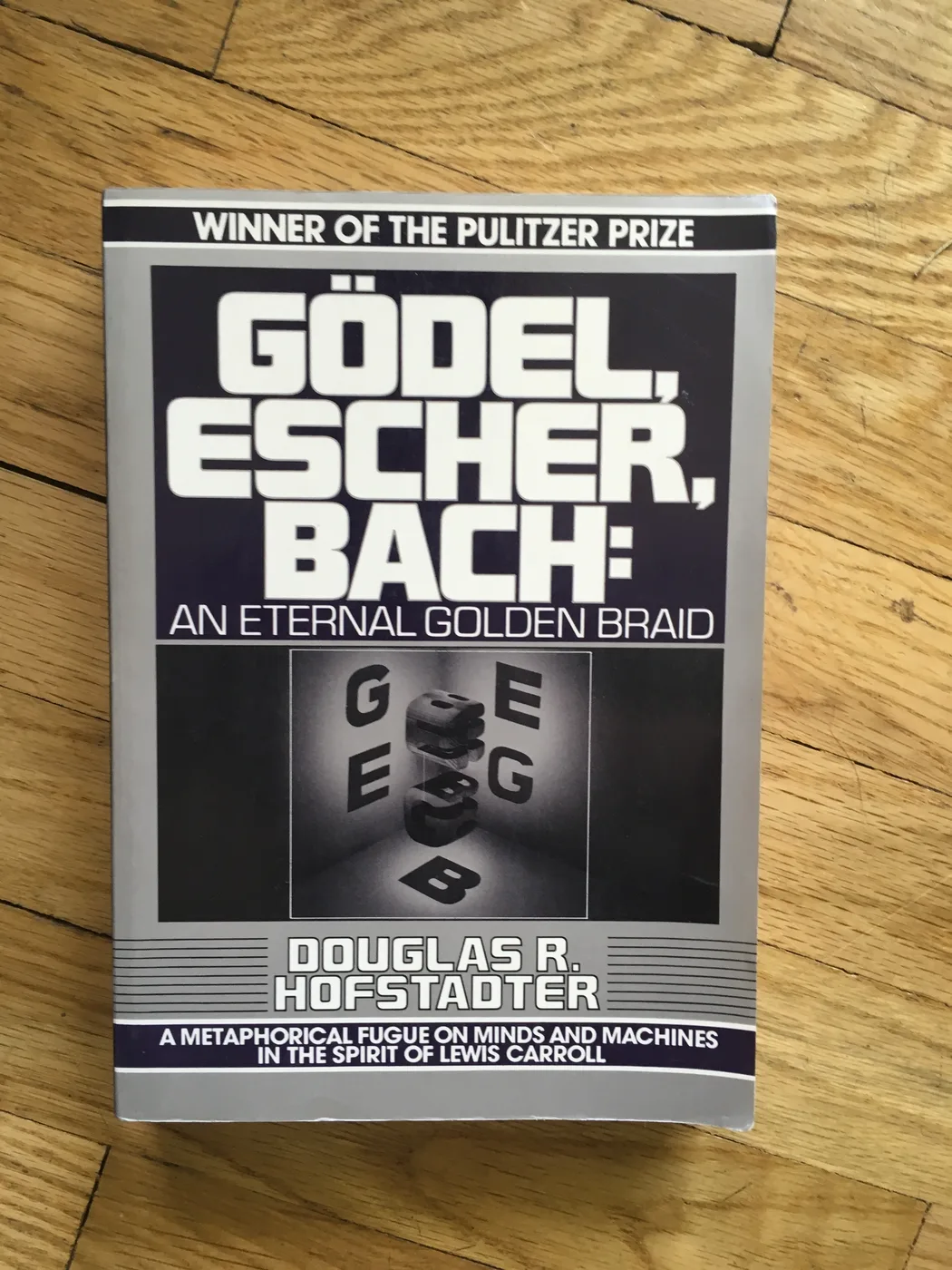
Douglas Hofstadter's 1979 debut is one of those rare books that made abstract ideas into a cultural event. Braiding together the incompleteness theorems of the logician Kurt Gödel, the recursive prints of M. C. Escher, and the canons and fugues of J. S. Bach, it asks how meaning and selfhood can arise from systems built out of meaningless parts—and, from there, how a mind might emerge from mere matter. Hofstadter alternates expository chapters with playful "dialogues" starring Achilles and the Tortoise, threading in formal logic, molecular biology, Zen, and early artificial intelligence. It won the Pulitzer Prize for General Nonfiction and the National Book Award, and despite its 700-plus pages became an improbable bestseller. Dense, witty, and endlessly digressive, it remains a favorite gateway drug into serious thinking about consciousness.
more…less ▴
The author
Douglas R. Hofstadter (b. 1945) is a cognitive scientist and the son of Nobel physicist Robert Hofstadter. He wrote Gödel, Escher, Bach as a young academic, and its runaway success made him an unlikely public intellectual. He later held a long professorship at Indiana University, directing research on analogy and "strange loops," and returned to the book's core question in I Am a Strange Loop (2007). He has also become a noted translator and a vocal skeptic of some hype around modern AI.
The book
The organizing conceit is the "strange loop": a system that, by referring to itself, gives rise to something genuinely new—Gödel's self-referential sentences, Escher's hands drawing hands, Bach's endlessly rising canon. Hofstadter's wager is that consciousness is such a loop, a pattern that becomes an "I." The alternating dialogues aren't decoration; they smuggle in the formal ideas the next chapter will unpack.
How it has aged
It remains a beloved classic, still assigned and still evangelized. Fair criticisms recur: it is long and digressive, its optimism about symbolic AI reads as a period piece, and specialists in logic sometimes find the Gödel exposition loose. Hofstadter himself has noted that readers often miss that the book is fundamentally about how selves and meaning arise, not a grab-bag of clever connections. None of that has dented its reputation as a singular achievement.
For more context
Read alongside I Am a Strange Loop, which distills the argument, and Ernest Nagel and James Newman's short Gödel's Proof for the underlying mathematics.
Sources
- Type
- Book
- Author / Maker
- Douglas R. Hofstadter
- Publisher
- Basic Books
- Place of publication
- New York
- Year
- 1979
- ISBN
- None
- Shelf
- Science
- Location
- Colorado