#000445
Man and His Symbols
Carl G. Jung (editor), with M.-L. von Franz, Joseph L. Henderson, Jolande Jacobi, and Aniela Jaffé
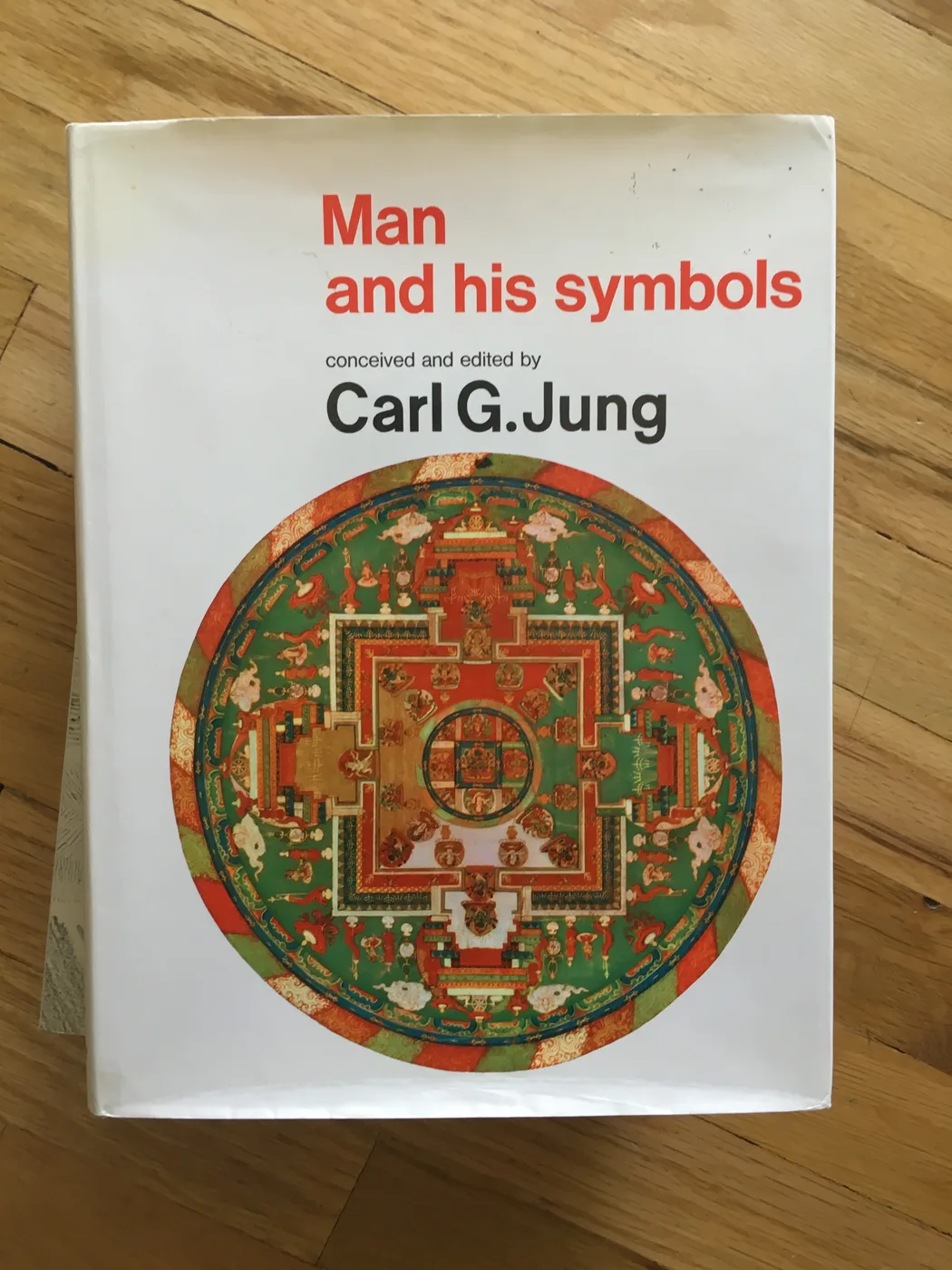
*Man and His Symbols* is Carl Jung's one deliberate attempt to explain his ideas to the general public, and it remains the best door into his thought. Conceived after a television interview persuaded Jung that ordinary readers deserved access to his work, it was the last project he undertook before his death in 1961—he wrote the opening essay and oversaw the rest, entrusting the remaining chapters to close associates including Marie-Louise von Franz and Joseph Henderson. The subject is the symbol: how the unconscious speaks through dreams, myth, and image, and why that language matters. Lavishly illustrated in the manner of its 1964 Aldus edition, it makes difficult material genuinely approachable without dumbing it down. For anyone curious about dreams, archetypes, or the shape of the psyche, it is a lucid, humane, and beautifully produced introduction to one of the twentieth century's great psychological visions.
more…less ▴
The author
Carl Gustav Jung (1875–1961) was the Swiss psychiatrist who broke with Freud to found analytical psychology, giving us the collective unconscious, archetypes, introversion and extraversion, and a lifelong preoccupation with dream and symbol. This book was, unusually, written for the lay reader at the very end of his life—the culmination of a career spent arguing that the unconscious speaks a symbolic language we ignore at our peril.
The book
The volume grew out of the Aldus Books publisher Wolfgang Foges, who after seeing Jung interviewed on television in 1959 pressed him to popularize his ideas. Jung agreed on condition that he could enlist trusted colleagues: the finished book, published in 1964, opens with his own essay and continues with chapters by Marie-Louise von Franz, Joseph L. Henderson, Jolande Jacobi, and Aniela Jaffé, all coordinated by John Freeman and richly illustrated.
How it reads
It is the most accessible thing Jung put his name to—clear, wide-ranging, and generous with pictures that illustrate its argument. Later readers debate how much is pure Jung and how much his circle, but as an introduction to Jungian thought it has never been bettered.
For more context
Readers can go on to Jung's Memories, Dreams, Reflections and to von Franz's own studies of fairy tales.
Sources - Wikipedia: Man and His Symbols - Internet Archive
- Type
- Book
- Author / Maker
- Carl G. Jung (editor), with M.-L. von Franz, Joseph L. Henderson, Jolande Jacobi, and Aniela Jaffé
- Publisher
- Aldus Books / Doubleday
- Place of publication
- London / New York
- Year
- 1964
- ISBN
- None
- Shelf
- Spirituality & Philosophy
- Location
- Colorado