#000429
Ananga Ranga: The Hindu Art of Love Illustrated
Kalyana Malla; translated by Richard F. Burton and F. F. Arbuthnot
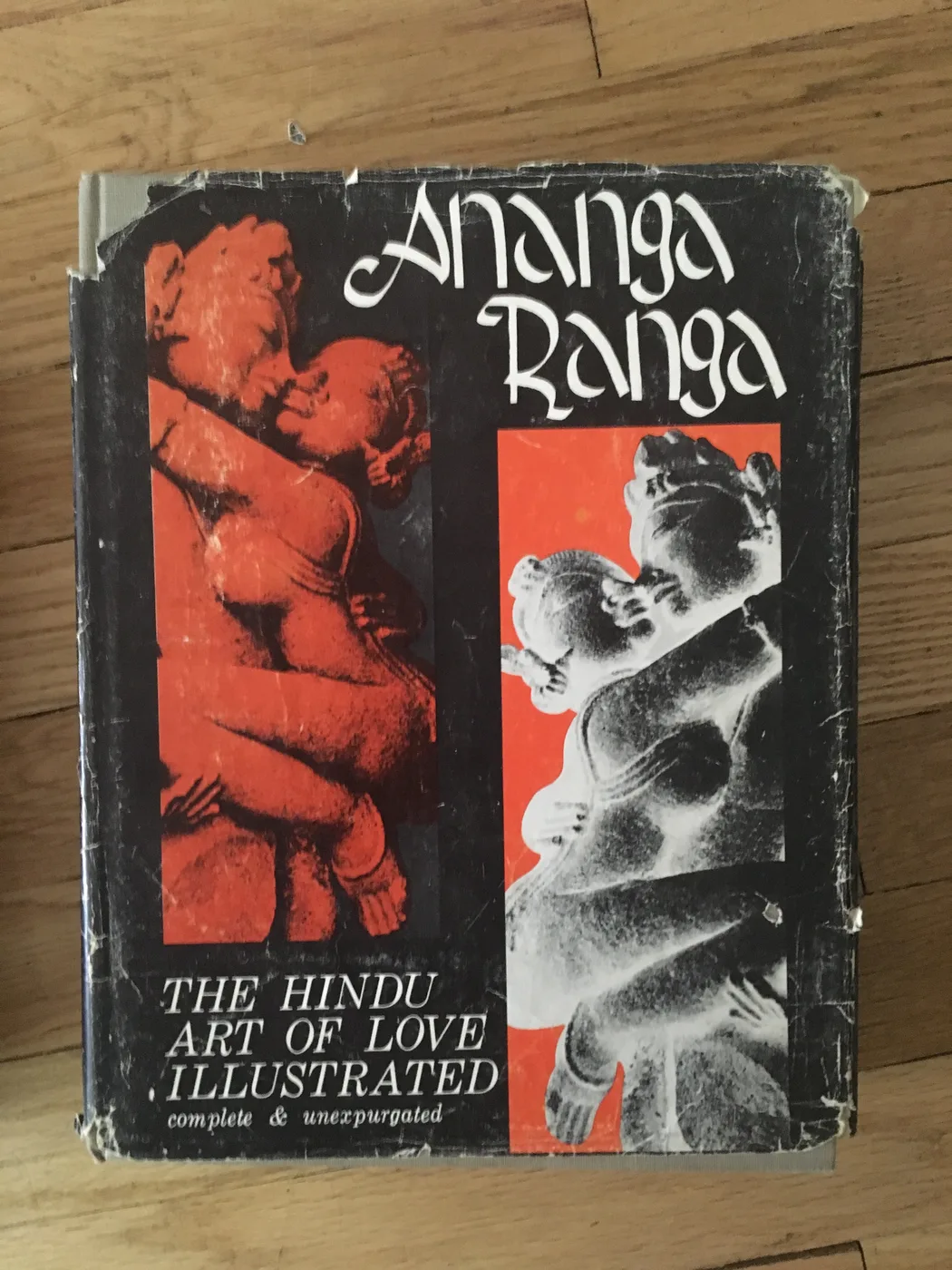
The *Ananga Ranga*—'Stage of the Bodiless One,' a name for the god of love—is a classical Sanskrit treatise by the poet Kalyana Malla, written to keep desire alive within marriage. This illustrated edition draws on the famous Victorian translation by Richard F. Burton and F. F. Arbuthnot, the same pair who brought the *Kama Sutra* to English readers. Where the *Kama Sutra* sprawls across the whole of social and erotic life, the *Ananga Ranga* is narrower and more practical, a manual addressed to married couples. This mid-century American printing, issued by the Medical Press of New York in 1964, adds drawings to the classic text and frames it, in the fashion of the day, as instruction rather than curiosity. It is a readable window onto both classical Indian erotology and the way the West received it.
more…less ▴
The author
The Ananga Ranga is attributed to Kalyana Malla, a poet writing in the late medieval period, who composed it as a practical treatise on married love. It reached English through the Victorian scholar-adventurer Richard F. Burton and his collaborator F. F. Arbuthnot, whose privately circulated translations of Indian erotic classics both scandalized and fascinated their era.
The book
Shorter and more focused than the Kama Sutra, the Ananga Ranga concentrates on sustaining desire between husband and wife, moving through classifications of temperament, timing, and technique. This 1964 illustrated edition from the Medical Press of New York is a period artifact in itself: it packages an ancient text with drawings and presents it under a veneer of clinical, marital instruction—the posture American publishers used to bring frank material past mid-century propriety.
How it has aged
The Burton–Arbuthnot rendering is more a Victorian recasting than a modern scholarly translation, and its framing reflects its time. Read today it is doubly interesting—as a glimpse of classical Indian thought about love, and as a document of how the West domesticated and marketed it.
For more context
It sits alongside the Burton circle's Kama Sutra and Perfumed Garden translations, and rewards comparison with later, more rigorous scholarship on Sanskrit erotology.
Sources - AbeBooks (1964 Medical Press edition) - Internet Archive
- Type
- Book
- Author / Maker
- Kalyana Malla; translated by Richard F. Burton and F. F. Arbuthnot
- Publisher
- Medical Press of New York
- Place of publication
- New York
- Year
- 1964
- ISBN
- None
- Shelf
- Spirituality & Philosophy
- Location
- Colorado
Places